Friday, May 10, 2013
Tip safely ride a motorcycle in the rain
- Do not forget to always bring a raincoat. When he started to rain and youre driving then do not panic stay calm and immediately to the edge to stop and use a raincoat. Make sure the head remains free for the movement should not be constrained by your raincoat. And make sure you do not cover the raincoat you to look back through the rearview mirror.
- Always bring a washcloth, and reserve sparkplug installer tool and release the spark plug. Why should carry spare spark plugs? Because we do not know when our bike broke down and did not know whether we strike when there is a motorcycle repair shop or a shop selling spare parts that are still open. In the big cities at this time when the rains often flood or any water that flooded roads, which are very prone to go on our motorcycle spark plugs. The main factor that often causes the motorcycle to strike when the rainy season is the spark plug intruding water. If the strike is off and clean the spark plugs and spark plug place. How to clean it, after the spark plugs in the spark plug cap off with a cloth and then do like when going to turn on a motorcycle. The aim is to dry the place of spark plugs from water. If you still can not then replace it with new spark plugs.
- Keep shoes do not wear flip-flops while driving a motorcycle let alone when it rains. In general, people love shoes more than salvation itself, but by using the shoes will make us safer while driving especially in the rain where many roads are slippery.
- When rain pants do the folding. Why? Because it can harm your feet. First exposed to the danger and the second motorcycle engine dangerous if dropped feet unprotected so prone to injury.
- When the rains make sure your bike lights are always lit. In rainy conditions reduce your speed in the drive even in a deserted place. Keep enough distance with the vehicle in front of you. The rain can hinder our view to it we must be careful because every time we may require action to stop suddenly possible because there are holes in the road, there may be people who cross the street, vehicles may also have the opposite direction to that is overtaking us. Well when it rains sometimes brakes not functioning as accurate as when it does not rain because even though the wheel has stopped motorcycle tires slippery enough to rub against the road. And remember when the brakes would be great if you use front and rear brakes simultaneously, and little by little.

Tuesday, May 7, 2013
The NOVA A Harley Davidson which was never born


Although HD are known to produce stylish lazy ‘Life Style’ bikes, its not very famous for ‘technologically’ advanced bikes until the VRSCA or V-Rod came in the picture. Even The V-Rod breaks very little technological ground compared to bikes from its competitors overseas. But for a brief, shining moment in the 70s, Harley sat poised to blow the roof off the motorcycle market-and its own reputation as a manufacturer of stodgy, technically unsophisticated products-with a dazzling new model powered by a water-cooled V-4, code-named Nova. That it never got passed the prototype stage is another matter altogether, but HD was and still is very reluctant to discuss about the Nova until after years of constant, good-natured badgering by American Rider, the story came to the world. Five Nova prototypes are still gathered together in one place in the Milwaukee factory. At the time of the Novas conception, Harleys were powered by big-bore, long-stroke, slow-revving pushrod engines. A healthy Harley in a good state of tune might register 50 horsepower on a rear-wheel dynamometer. The plethora of short-stroke, water-cooled, overhead-cam engines that the overseas competition would eventually usher in were still just a gleam in their designers eyes. But in 1976 Harley put into motion a plan to design and produce a radically new family of motorcycles powered by a series of engines that would incorporate all those modern features...and produce up to 135 horsepower.


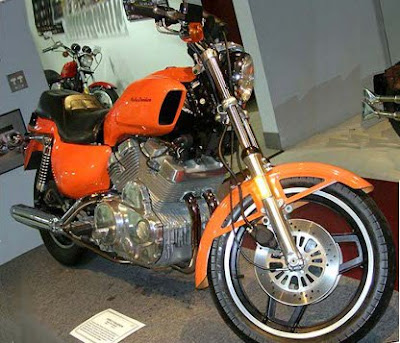
Left picture courtesy - Lee A. Wood, Source - Bearspage
What happened?
The Nova grew out of a series of meetings held in mid-1976 that is still referred to in Harley executives lingo as the Pinehurst meetings. There it was decided that due to the proliferation at the time of high-tech motorcycles from other countries, and their wide acceptance by American motorcyclists, a redesign of the current 74 (1,200cc) shovelhead engine would be insufficient to guarantee the companys long-term growth. So planners proposed a two-pronged strategy to ensuring Harleys future. First, because of the established product lines loyal following, they set into motion an advanced V-twin project with the goal of updating the shovelhead Big Twin and Ironhead Sportster. The eventual result was the Evolution engine. At the same time, an all-new machine with advanced technology would be developed to appeal to riders who wanted more contemporary performance. Harleys engineers laid out a number of concepts including a series of motorcycles powered by three basic multicylinder, water-cooled engines in six displacements-the Nova family-all incorporating the latest technology. Subsequently, the planners had mapped out Harleys future as a manufacturer of both traditional and cutting-edge motorcycles. The Novas mission was to penetrate the 500cc to 1,000cc market-Harleys smallest air-cooled V-twin engine was 1,000cc (the Sportster)-and attract the growing population of performance-hungry riders.


The Nova family, which perfectly bracketed the most popular segments of the world market, could both fill voids in the American market and give Harley a presence on the international scene. But Harleys engineering resources would be severely stretched with both programs. While most of the designers were motorcycle enthusiasts, not all were card-carrying engineers. The task of developing the Evo, in both Sportster and Big Twin iterations, was daunting enough-the Nova would overload H-Ds engineering capacity. The solution was to farm out the powertrains design and development. Harley solicited detailed design proposals from three companies, Porsche was eventually selected and subcontracted at the end of 1979 to design and develop the Nova engine and transmission. All chassis development and testing would be done in Milwaukee. To cover the desired range of displacements, the Nova family would share many common, interchangeable components. The basic concept revolved around a 60-degree V-cylinder arrangement of two, four and six cylinders. Other requirements included liquid cooling, double overhead camshafts, a balance shaft to reduce vibration and a five-speed gearbox. The valve gear and even the gearbox were to be interchangeable. In addition to carbureted models, a fuel-injected version would also be developed. All the engines were designed to use either 200cc or 250cc "wet" cylinder liners and pistons.  These would interchange between the V-twin, V-4 and V-6 engines. So the 800cc and 1,000cc fours are basically made of two 400/500cc twins, and the 1,200cc and 1,500cc six-cylinder versions consist of three banks of twins. The bore sizes were set at 66mm and 74mm (2.60 and 2.91 inches) for the 200cc and 250cc cylinder displacements, respectively, with a common stroke of 58mm (2.28 inches). This gave a very modern oversquare bore/stroke ratio of 1.14:1 for the smaller engine and 1.28:1 for the larger size. The short stroke would allow these engines to rev safely to nearly 10,000 rpm, an impossible speed for a 5,000-rpm Big Twin with its long stroke of nearly 4 inches. The cylinder heads feature two valves with bucket tappets actuated directly by overhead cams. Harley looked seriously at a four-valve head, but staying close to its conservative philosophies, chose the least complicated configuration while not ruling out a change later on-the production two-valve heads were designed to be adaptable to a four-valve layout. Harley engineers had developed a preliminary design for the entire family before the detail design of the first engine-the 800cc Nova 8-was started. This size was considered the middle ground of displacement ranges thought to be the most promising. The cylinder bore and stroke were also based on engineering analysis of noise management, something Porsche had considerable experience with. As engine development proceeded, the chassis designers weighed the final-drive options. Belt final drive was not perfected then, and they chose not to trust it for the high-performance Nova. That left either shaft drive and chain drive. Despite its advantages in terms of cleanliness and low maintenance, shaft drive was seen as too complex, too heavy, and too costly to repair or replace. It also absorbed about three percent of the engines power every time the drive changed direction, twice in the Novas case. Despite Harley engineerings reluctance to adopt the shaft, it proceeded with that alternative. In fact, there was even open discussion of turning the engine 90 degrees in the frame, with the cylinders protruding sideways in an arrangement similar to Moto Guzzis; this would eliminate one of the two right-angle drives in the shaft. That discussion was quickly dropped. By the time the FLT hit the market in the fall of 1979, belts had been proven and the shaft lost what little appeal it had for Harley engineers. The final drive of choice became the belt, with a chain option. Besides, if needed, the shaft could always be resurrected in the future.


The Nova was never intended to look like any of the traditional Harley V-twins, since its target market consisted of performance-oriented riders accustomed to the styling of Harleys overseas competition. But Willie G. Davidson, who oversaw the Novas appearance, refused to buy into the function-over-form philosophy prevalent in the styling of high-performance bikes of the day, insisting that a large, flat radiator stuck on the front of the bike was an affront to the eye. It was his insistence on a concealed radiator that led to one of the Novas most unusual-and patented-features, an underseat radiator. The radiator lies almost horizontally, with two large forward-facing scoops protruding forward from what normally would be the fuel tank, funneling air into a plenum chamber above the radiator. A fan under the radiator pulls air through it, down and rearward, away from the rider and passenger. What began as a styling imperative offered inherent advantages. The air intake is mounted well above ground level, preventing debris from being sucked into the radiator. Because the airflow is channeled and controlled, a smaller radiator can be used with greater efficiency. And almost as important at the time, the "invisible" radiator kept Willie G. and his stylists happy. A pressed-steel backbone-style frame-strong, light, and easy to manufacture-has a rear subframe welded to it, and uses the engine as a structural member. With no front downtubes or radiator, the engine bay has a clean look, and the cylinders "cooling fins" give the engine an appearance of being air-cooled. With the fuel tank displaced from its traditional location by the cooling system, H-D engineers designed a saddlebag-style tank that straddles the radiator. There is a distinct advantage in this location: a lower center of gravity. Engineers had minor concerns about the possibility of vapor lock caused by radiator heat, and the problems associated with the fuel pump and plumbing-required by the tanks low position-but these issues were considered easily surmountable. The tanks placement also limits fuel capacity, and therefore range.


The solution, though not elegant, is huge side panels, perhaps the Novas single styling blemish. As dyno rooms hummed and prototypes logged test mileage, the Nova appeared close to launch. A project of the Novas scope, however, required solid backing from the check-writers at the corporate level, and Harleys parent company at the time, American Machine and Foundry (AMF) not only backed the Nova, but supported Harleys overall growth. Under the direction of AMF president Rodney C. Gott, who was a motorcycle enthusiast, Harley acquired the York final-assembly plant. The company grew with the influx of capital, and new people were brought in. In the years of 1978 through 1980, the motorcycle division was perhaps AMFs largest profit center.Then Gott retired, Tom York took over AMF, and the outlook suddenly changed. Previously AMFs business was roughly half industrial and half leisure, Harley being part of the latter group. In a major shift in strategy, York ordered the expansion of the industrial side, and financed it with profits from the leisure side. Under this plan Harley-Davidson, AMFs largest profit generator, would become the cash cow, milked of capital to feed other business interests. The Nova project, ultimately considered expensive and risky, fell victim to the bottom line, and was terminated.
In a way, however, the Novas demise sparked Harley-Davidsons resurgence. Cutting Nova funds was one of the reasons Beals led the so-called "gang of 13" to propose buying the company back from AMF. AMF agreed, and by mid-1981 Harley-Davidson became a privately held company. Highly leveraged with an enormous bank debt, Harleys future options boiled down to just two-either continue development of the Evolution V-twin, or build the Nova. The Nova was the long-range hope, the 10-year promise. But air-cooled twins promised the most immediate cash flow. And so the Nova died yet another death. Even so, Harley execs continued searching for investors to fund a manufacturing plant for the Nova. As late as 1984 Beals made presentations to many companies in the United States and Europe, but had no success. Among the what-ifs that inevitably attend a story of shattered dreams are these: What if Harley-Davidson had gone ahead with the Nova? What would it look like today, and how would it compare to its competition? And theres another question thats just as intriguing; what if Harley had chosen the other path, and dropped the Evolution altogether in favor of the Nova?
Another Harley Davidson prototype was the VR-1000 (picture below). The story... here

Sunday, May 5, 2013
Correction on a previous NORTON post
I had made a post of a NORTON 650SS restoration or so that was what I thought. Today I got some mails from Mr. Gary Parker who is the Canadian representative for the International Norton Owners Association stating that the mentioned bike is actually a Norton Atlas 750. He had justified his statement through his mails. When a person of his stature has confirmed about the Norton, than I guess, we can rest all doubts about the model. I got quite a few mails with the queries surrounding the mystery of the bike. I guess the following mail from Mr. Gary Parker will restsHello there, My name is Gary J Parker, and I am the Canadian representative for the International Norton Owners Association. The bike in the photos that are posted on the "Visual Gratififcation" blog are of a Norton Atlas 750. They are NOT from a 650SS or a Commando. There are a number of ways we can identify this.
all doubts.
1) The engine breather on an Atlas (and very early Commandos) exits the engine on the front drive side, off the end of the camshaft, whereas the 650SS engine breather exits the engine at the REAR of the drive side crankcase. As you can see from the photo of the drive side, there is an angled pipe on the front drive side which eliminates the possibility that this engine is a 650. That area would be bare if this was a 650 engine. The pipe is almost uniquely Atlas.
2) Commando top end oil feed is from the sides of the head, between the rocker spindle cover plates, google any image of a Commando and you will see the oil feed in the space between the spindle covers, whereas the Atlas has its oil feed from the top of the head, on either side of the head steady. On your engine, the area between the spindle cover plates is bare, indicating that the head at least is not a Commando head.
3) Your engine has a tach drive, which only the very earliest Commandos were fitted with. 4) Interestingly, your bike is equipped with a "Laid down" Norton gearbox, a design which was changed in 1956, all later Norton twins were equipped with the AMC gearbox, which continued till the Commando. For reference, there were no 650 or 750 motors being built by Norton in 1956. This box is from a much earlier bike.
5) Another interesting thing is the cylinder block, whch is not stock Norton, the fins are too few and spaced too far apart. This cylinder block is in all likelihood a Dunstall kit, bored out to 810 cc. It is DEFINITELY NOT Norton, but aftermarket and desirable. Paul Dunstall marketed "Go Fast" goodies and tuning kits back in the late sixties and early seventies.
Any more questions i would be happy to answer.
cheers, Gary J Parker,
Canadian Rep,
INOA Victoria BC Canada
Well, I also thought that it may be a Commando, but Gary has very clearly put that it is not. He sent some more proof in his second mail.More: Looking again at the pics, i have come to some conclusions. This bike was originally an early to mid fifties Norton Dominator or single, in all likelihood a bike which had a catastrophic engine failure. The frame and all cycle parts are too early to be Atlas (Or 650SS for that matter)
the frame number (Located on the metal flange which is directly behind the primary chaincase) will tell a great deal but the frame is quite early, I would say 53-55, and may even be from an International or Manx OHC single. It is definitely "Wideline" or pre -1960.
My conclusion, a long time ago someone with a wideline Dommie or Inter blew their engine up and found a mid sixties Atlas with a Dunstall big bore kit and plumbed it in.
cheers, Gary
PS search for frame numbers and engine number is on front drive side of crankcase just below barrels.
I am very familair with the Norton Dominator/Atlas/650SS/Mercury series of bikes, I own two and have restored a couple more.
cheers, Gary
I recieved another mail from him with his final thoughts.OK, More conclusions. Sometimes it takes quite a few looks to get familiar with something. Some things are obvious, some things must be inferred by context and "Feel".
Engine: 750 Atlas engine, 1963-68, fitted with Dunstall overbore kit, possibly 810cc. will be stamped thus: 20 xxxxxx or something along those lines, followed by the letter "P". Possibly stamped N15CS xxxxxx (xxxxxx indicates actual serial number) If the latter is the case, then the engine, while identical to an Atlas, came from a Matchless/Norton hybrid scrambler, made between 65 and 68.
Gearbox: pre 57 "Laid down" Norton box, 4 speed. Carburetion: Wal Phillips Fuel Injectors, rare nowadays, period aftermarket "Go Fast" goody commonly used in the sixties, difficult to find now.
Frame; Looking more and more like a Manx or Inter OHC single frame, the key is the curve to the rear of the engine, the twin frames had a tighter bend, frame number if found will tell. Definitely pre -1960 which eliminates as noted any likelihood of it being a 650SS. This baby is a true "Bitza". Frame number, as previously noted, will be found on the flange to the rear of the primary thus: 122 or 14 or something like that, the 122 if present would indicate a Domi 88 500cc, the 14 indicates a Domi 99 600cc. These are model deignations, the actual serial numbers follow. If the frame is a true Inter or Manx, instead of 122 or 14, the horizontal number will be either 10, 10M2, 11 or 11M2. Let me know what you find, Im curious. The frame, although early, is not TOO early, being post 54 as the rear section was bolted on prior to that, not welded as in this case. The shocks are Armstrong, not Girling, so mid fifties is what Im thinking. the rear brake has been heavily altered and may not be Norton at all, it has a bolt on sprocket, which Norton roadsters didnt have at the time. the front wheel (Or at least the hub) is conical, possibly Manx, but there is also the possibility it might be late Triumph, but Im betting on Manx or International. The front guard is Inter or manx pattern.
My conclusion then, the bike was a racing Inter or even a Manx (again, without numbers its very difficult), the engine blew or was removed for some reason, and a modified Atlas engine was installed in its place, complete with the Wal Philips rig.
you have a very interesting and unusual bike here, rather a bitza but a good one. Incidentally, the bike in the background in the picture of the timing side is a 57-59 Dominator i think but it isnt clear enough to tell.
cheers, Gary
The third letter had me dumbfounded. There was no question of doubt even after the first letter, but the second and the third... the third was actually too technical and a lot of things flew over my head. I read it thrice, still... I could only capture some ideas what Gary was saying. And I am sure lots of us will feel the same.
This man is a genius on Nortons, what an amazing amazing techno person. Any person on earth having any doubts on his Norton can mail him at atlas65@shaw.ca and I bet even if you have a mudguard from a Norton, Gary will be able to recognize the model!
Thank You Gary, you are amazing... REALLY!
Before any gentleman get to having second thoughts on certain things Gary had mentioned, please note that his comments are guesswork based on experiences with these machines. After reading the post, he specifically mentioned to add a few more notes to clarify things.


Friday, May 3, 2013
D66 A DUCATI Chopper


This is the Ducati D66, a custom chopper made by Luca Bar from Italy. Come to think about it, how many European Bike manufacturers (except for TRIUMPH) has production cruisers or choppers? Certainly not Ducati or MV or Laverda. But then, come to think about it, if you want to make them, Luca Bar has just shown it how it should be done.


Source: INFOMOTORI through Motorcycle Specs

