Tuesday, May 28, 2013
2011 Harley Davidson FXDC Dyna Super Glide Custom Specs News and Review
 |
| 2011 Harley-Davidson FXDC Dyna Super Glide Custom |
 |
| 2011 Harley-Davidson FXDC Dyna Super Glide Custom |
U.S. MSRP - Vivid Black $12,999. Solids $13,374. Two-Tones $13,694. Custom Colors $13,864
- Length 92.9 in. (2360 mm)
- Overall Width 38.9 in. (988 mm)
- Overall Height 48.5 in. (1232 mm)
- Seat Height:
- • Laden2 26.3 in. (668 mm)
- • Unladen 26.5 in. (673 mm)
- Ground Clearance 4.6 in. (117 mm)
- Rake (steering head) 29°
- Fork Angle 29°
- Trail 4.7 in. (119 mm)
- Wheelbase 64.2 in. (1631 mm)
- Tires (Michelin® Scorcher™ “31” front and rear):
- • Front – Scorcher™ “31” 100/90-19 57H
- • Rear – Scorcher™ “31” 160/70-17 73V
- Fuel Capacity 5.0 gal. (18.9 L) (warning light at approximately 0.9 gal.)
- Oil Capacity (w/filter) 3.0 qts. (2.8 L)
- Transmission Capacity 1.0 qts.
- Primary Chain
- Case Capacity3 1.0 qts.
- Weight:
- • As Shipped 645 lbs. (292.6 kg)
- • In Running Order 676 lbs. (306.7 kg)
- • Gross Vehicle Weight Rating 1085 lbs. (492.2 kg)
- • Gross Axle Weight Rating:
- • Front 390 lbs. (176.9 kg)
- • Rear 695 lbs. (315.3 kg)
- Engine4 Air-cooled, Twin Cam 96™
- Valves Pushrod-operated, overhead valves with hydraulic, self-adjusting lifters; two valves per cylinder
- Bore x Stroke 3.75 in. x 4.38 in. (95.3 mm x 111.3 mm)
- Displacement 96 cu. in. (1584 cc)
- Compression Ratio 9.2:1
- Fuel System4 Electronic Sequential Port Fuel Injection (ESPFI)
- Air Cleaner Fiberglass Media, washable
- Lubrication System Pressurized, dry-sump
- Primary Drive Chain, 34/46 ratio
- Final Drive Belt, 32/66 ratio
- Clutch Multi-plate, wet
- Transmission 6-Speed Cruise Drive®
- U.S. Gear Ratios (overall):
- • 1st 9.311
- • 2nd 6.454
- • 3rd 4.793
- • 4th 3.882
- • 5th 3.307
- • 6th 2.79
- Frame Mild steel, tubular frame; rectangular section backbone; stamped, cast, and forged junctions; forged fender supports; MIG welded
- Swingarm Mild steel, rectangular tube sections, stamped junctions; MIG welded
- Front Forks 49 mm with polished aluminum fork triple clamp and dual-rate springs
- Rear Shocks Coil-over shock
- Wheels5 (Chrome, Profile Laced Aluminum, front and rear option):
- Chrome, Laced Steel
- • Front 19 in. x 2.5 in. (483 mm x 64 mm)
- • Rear 17 in. x 4.5 in. (432 mm x 114 mm)
- Brakes:
- • Caliper Type 4-piston fixed front, and 2-piston torque-free floating rear
- • Rotor Type (diameter x width): Patented, uniform expansion rotors (floating, front only)
- • Front (floating) 11.8 in. x .2 in. (300 mm x 5 mm)
- • Rear 11.5 in. x .23 in. (292 mm x 6 mm)
- Suspension Travel:
- • Front Wheel 5 in. (127 mm)
- • Rear Wheel 3.1 in. (78.74 mm)
- Engine Torque6 (per SAE J1349):
- • North America 92 ft. lbs. @ 3000 RPM (125 Nm @ 3000 RPM)
- Lean Angle:
- • Right 29.5°
- • Left 30.9°
- Fuel Economy7
- (EPA urban/highway test) 34/53 mpg (6.90/4.40 L/100 km)
- Battery (per Battery Council International Rating)
- Sealed, maintenance-free, 12V, 19-amp/hour, 270 cca
- Charging Three-phase, 40-amp system
- (493W @ 13.5V, 2000 RPM, 540W max power @ 13.5V)
- Starting 1.2 kW electric with solenoid shift starter motor engagement
- Lights (as per country regulation):
- • Headlamp (quartz halogen) 55-watt low beam, 60-watt high beam
- • Tail/Stop Lights 8W/28W (5W/21W)
- • Turn Signal Lights 28W (21W) self-canceling
- • Indicator Lamps - High beam, directional light bar, neutral, low oil pressure, engine diagnostics, turn signals, security system8 (optional), 6-speed, low fuel warnings
- Electric Power Outlet Standard
- Solids
- • Vivid Black
- • Scarlet Red
- Two-Tones
- • Cool Blue Pearl/Vivid Black
- • Dark Candy Root Beer/Light Candy Root Beer
- Custom Colors
- • Pyschedelic Purple/Vivid Black
- • Apple Green/Vivid Black
- Warranty 24 months (unlimited mileage)
- Service Interval First 1,000 miles (1,600 km), every 5,000 miles (8,000 km) thereafter :
- Vehicles depicted may differ from vehicles manufactured and delivered. Specifications and prices listed may differ from specifications and prices of vehicles manufactured and delivered. All product descriptions (including depictions, specifications, dimensions, measurements, ratings and competitive comparisons) are based on available information at the time of publication. Although such descriptions are believed correct, errors and changes can occur and complete accuracy cannot be guaranteed. Harley-Davidson may make changes at any time to prices and specifications, and may change or discontinue models, without notice and without incurring any obligation. Attention: Vehicles in the configurations shown and many of the accessories described in this catalog may not be available for sale or use in some locations. Please check with your dealer for complete product details and the latest information. All models feature 6-speed transmission (VRSC™ models and Sportster® models are 5-speed) and carbon fiber belt final drive; multi-plate clutch with diaphragm spring in oil bath; and 2-year unlimited mileage warranty.
- Measurement reflects 180 lb. (81.7 kg) operator weight.
- Primary case oil fill is 32 oz. or as needed to fill to bottom of diaphragm.
- Recommended 91 octane or higher fuel (R+M)/2.
- Standard and optional wheels may vary by country and region.
- Values shown are nominal. Performance may vary by country and region.
- Estimated from fuel economy tests on a sample motorcycle from the corresponding family conducted by Harley-Davidson under ideal laboratory conditions. Not all motorcycle models undergo fuel economy testing. Fuel economy and mileage may vary among motorcycle models within a family. Your mileage may vary depending on your personal riding habits, weather conditions, trip length, vehicle condition and vehicle configuration and other conditions. Break-in mileage may vary.
- North America security system includes immobilizer; outside North America the security system includes immobilizer and siren.
- See motorcycle owner’s manual for complete details.

Wednesday, May 22, 2013
2012 Harley Davidson FLHTCUTG Tri Glide Ultra Classic Review
The three-wheel pioneer designed to be the ultimate badass touring machine.
The Tri Glide™ Ultra Classic® is a full-feature, factory motorcycle built to confidently chase the horizon with long-haul comfort and freedom on three wheels. The Harley-Davidson® Trike platform brings original-equipment design, quality and service to the three-wheel motorcycle segment. Experienced two-wheel touring enthusiasts have an authentic three-wheel alternative with real performance, excitement and style that
is truly Harley-Davidson. The Tri Glide™ Ultra Classic® Trike features ultra-comfortable, long haul conveniences, a large Twin Cam 103™ engine, lengthened and raked front fork with steering damper, a deluxe Tour-Pak® carrier and integrated trunk for 6.5 cubic feet of storage. 2012 Trike Models: Three Wheelin

With a deluxe Tour-Pak® carrier and integrated trunk, a four-speaker/80-watt Harman/Kardon® Advanced Audio System, electronic cruise control and electric reverse drive, the Tri GlideTM Ultra Classic® motorcycle inspires confidence, passion and independence in any riding situation. SEAMLESS STYLING AND MATCHING PAINT
From the smooth, classically designed lines to the front-to-rear matching paint, the Tri Glide™ Ultra Classic® model has the bloodlines of a true Harley-Davidson® motorcycle through and through.
SPLIT SEVEN-SPOKE FRONT AND REAR WHEELS
No Harley-Davidson® motorcycle is complete without a killer set of wheels.
KING TOUR PAK® AND TRUNK
Bigger metal flakes.
HAND FINISHED FUEL TANK
TWIN CAM 103™ ENGINE INNOVATION
Fire up the air-cooled, rubber-mounted Twin Cam 103™ engine and feel the low-end torque unleashed for a smooth ride. Six speeds.
PURE HARLEY-DAVIDSON STYLING
Feast your eyes on the Twin Cam 103™ engine and theres no mistaking its roots.
SIX-SPEED CRUISE DRIVE®
FOUR-POINT ENGINE ISOLATION SYSTEM
TWIN CAM 103™ ENGINE POWER
The air cooled Twin Cam 103™ Harley Davidson® engine delivers more stump pulling torque, while its Electronic Sequential Port Fuel Injection jetting gives crisp, lively throttle reaction.
TWIN CAM 103™ ENGINE HERITAGE
Saturday, May 11, 2013
2013 Harley Davidson Ultra Classic Electra Glide 110th Anniversary

2013 Harley Davidson Ultra Classic Electra Glide 110th Anniversary Motorcycle Reviews
2013 Harley Davidson Ultra Classic Electra Glide 110th Anniversary
For Celebrate 110th Anniversary Harley-Davidson Motorcycle,They Released Many Motorcycle Models.Harley-Davidson Has production the 110th Anniversary Edition Models Very Limited Edition.The 2013 Harley Davidson Ultra Classic Electra Glide Is the One models of them.

The 2013 Harley Davidson Ultra Classic Electra Glide 110th Anniversary model (limited to 1,100 motorcycles). Harley Davidson Ultra Classic Electra Glide Is The super-premium touring motorcycle is fully equipped and stylishly appointed. New features for 2013 include the chrome and rubber Slipstream Collection heated hand grips, rider and passenger foot board inserts, brake lever pad, shifter and highway pegs and windshield trim. The suspended, dual-control heated, two-up seat and adjustable passenger backrest have a new perforated leather insert.
The 2013 Harley Davidson Ultra Classic Electra Glide 110th Anniversary highlight of each model are solid bronze fuel tank badges, plated in black nickel and then distressed to highlight the bronze. A bright gold-tone Bar and Shield cloisonne is inserted in the main body of the "single wing" badge while each motorcycle will carry other model-specific anniversary banging, trim and a serialization badge.

New for 2013, Harley-Davidson launches Hard Candy Custom , a styling movement rooted in themes first seen in the chopper era of the late 1960s that embraces dazzling metal flake paint, brilliant chrome, and styling details in accessories, gear and apparel. Hard Candy Custom elements include "big flake" paint finishes, three of which will be selectively offered as a solid-color option on five Harley-Davidson production motorcycles for 2013.

2013 Harley Davidson Ultra Classic Electra Glide 110th Anniversary - Specifications
DIMENSIONS
Length 98.8 in. (2535 mm)
Overall Width 38.4 in. (975 mm)
Overall Height 56.5 in. (1435 mm)
Seat Height:
• Laden2 27.8 in. (706 mm)
• Unladen 29.1 in. (740 mm)
Ground Clearance 4.9 in. (125 mm)
Rake (steering head) 26°
Fork Angle 29.3°
Trail 6.69 in. (170 mm)
Wheelbase 64.4 in. (1635 mm)
Tires (Dunlop® Harley-Davidson® Series, bias blackwall front and rear):
• Front – D408 130/80B17 65H
• Rear – D407 180/65B16 81H
Fuel Capacity 6.0 gal. (22.7 L) (warning light at approximately 1.0 gal.)
Oil Capacity (w/filter) 4 qts. (3.8 L)
Transmission Capacity 1 qt. (1 L)
Primary Chain
Case Capacity 1.4 qts. (1.3 L)
Weight:
• As Shipped 897 lbs. (407 kg)
• In Running Order 948 lbs. (430 kg)
• Gross Vehicle Weight Rating 1360 lbs. (617 kg)
• Gross Axle Weight Rating:
• Front 500 lbs. (227 kg)
• Rear 927 lbs. (420 kg)
ENGINE
Engine Air-cooled, Twin Cam 110™
Valves Pushrod-operated, overhead valves with hydraulic, self-adjusting lifters; two valves per cylinder
Bore x Stroke 4 in. x 4.38 in. (101.6 mm x 111.1 mm)
Displacement 110 cu. in. (1802 cc)
Compression Ratio 9.15:1
Fuel System3 Electronic Sequential Port Fuel Injection (ESPFI)
Air Cleaner Ventilator intake with chrome cover, fiberglass media, washable exposed element with rain sock
Lubrication System Pressurized, dry-sump
DRIVETRAIN
Primary Drive Chain, 34/46 ratio
Final Drive Belt, 32/68 ratio
Clutch Hydraulically actuated, 9-plate wet with high performance spring
Transmission 6-speed Cruise Drive®
Gear Ratios (overall): U.S.
• 1st 9.593
• 2nd 6.65
• 3rd 4.938
• 4th 4
• 5th 3.407
• 6th 2.875
CHASSIS
Frame Mild steel; tubular frame, two-piece stamped and welded backbone; cast and forged junctions; twin down tubes; bolt-on rear frame with forged fender supports; MIG welded
Chrome dual exhaust with 4 in. touring mufflers and touring muffler shields
Diamond Dust & Obsidian with Palladium graphics
Swingarm Mild steel; two-piece drawn and welded section; forged junctions; MIG welded
Front Forks 41.3 mm telescopic, with blow-by valve
Rear Shocks Air-adjustable
Wheels4: Mirror Chrome Chisel Custom wheels
• Front 17 in. x 3 in. (432 mm x 76 mm)
• Rear 16 in. x 5 in. (406 mm x 127 mm)
Brakes:
• Caliper Type 32 mm, 4-piston fixed front and rear
• Rotor Type (diameter x width): Dual floating rotors (front), fixed rotor (rear)
• Front (dual) 11.81 in. x .2 in. (300 mm x 5 mm)
• Rear 11.81 in. x .28 in. (300 mm x 7 mm)
• Anti-lock Braking System Standard
Suspension Travel:
• Front Wheel 4.6 in. (117 mm)
• Rear Wheel 3 in. (76 mm)
PERFORMANCE
Engine Torque5 (per J1349):
• North America 118 ft. lbs. @ 3750 RPM (160 Nm @ 3750 RPM)
Lean Angle (per J1168):
• Right 33°
• Left 31°
Fuel Economy6 (EPA urban/highway test)
41 mpg (5.7 L/100 km)
ELECTRIC
Battery (per Battery Council International Rating)
Sealed, maintenance-free, 12V, 28-amp/hour, 270 cca
Charging Three-phase, 50-amp system (585W @ 13V, 2000 RPM, 650W max power @ 13V)
Starting 1.4 kW electric with solenoid shift starter motor engagement
Lights (as per country regulation):
• Headlamp (dual bulb halogen) 55-watt low beam, 120-watt high beam
• Tail/Stop Lights 8W/28W
• Turn Signal Lights 28W self-canceling
• Indicator Lamps: High beam, neutral, running lights, turn signals, low oil pressure, engine diagnostics, cruise control, speakers,
accessory, security system7, 6-speed, low fuel warning, ABS
The Price for 2013 Harley Davidson Ultra Classic Electra Glide 110th Anniversary In USA is:$38,599 USD
2011 Harley Davidson CVO Road Glide Ultra Review
The street Slip is actually recognized through its special dual-headlight prow from the frame-mounted fairing. This particular CVO edition is actually aesthetically arranged aside through its Reflection Stainless Agitator tires, eighteen in . within size entrance as well as back, as well as brand new billet muffler finish hats along with dark spears. You’ll additionally spot the Rumble Selection feet regulates, decorative mirrors as well as saddlebag latch handles, just about all bathed within wealthy, heavy stainless. Cut sections for that CB pod place, Screamin’ Bald eagle 110 consumption place, as well as Tour-Pak cover place have a brand new diamond-cut design.


Friday, May 10, 2013
Harley Davidson fatboy Terminator Motorcycle Photos
 |
| Harley Davidson fatboy Terminator Motorcycle and actor Arnold Photo |
 |
| old 1990 Harley Davidson fatboy Terminator 1 cruiser bike photos |
 |
| 1990 Harley Davidson fatboy Terminator Motorcycle |
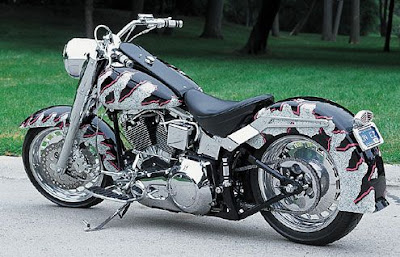 |
| Custom Harley Davidson fatboy Terminator Motorcycle |
 |
| Harley Davidson fatboy Terminator Bike Picture |
Tuesday, May 7, 2013
The NOVA A Harley Davidson which was never born


Although HD are known to produce stylish lazy ‘Life Style’ bikes, its not very famous for ‘technologically’ advanced bikes until the VRSCA or V-Rod came in the picture. Even The V-Rod breaks very little technological ground compared to bikes from its competitors overseas. But for a brief, shining moment in the 70s, Harley sat poised to blow the roof off the motorcycle market-and its own reputation as a manufacturer of stodgy, technically unsophisticated products-with a dazzling new model powered by a water-cooled V-4, code-named Nova. That it never got passed the prototype stage is another matter altogether, but HD was and still is very reluctant to discuss about the Nova until after years of constant, good-natured badgering by American Rider, the story came to the world. Five Nova prototypes are still gathered together in one place in the Milwaukee factory. At the time of the Novas conception, Harleys were powered by big-bore, long-stroke, slow-revving pushrod engines. A healthy Harley in a good state of tune might register 50 horsepower on a rear-wheel dynamometer. The plethora of short-stroke, water-cooled, overhead-cam engines that the overseas competition would eventually usher in were still just a gleam in their designers eyes. But in 1976 Harley put into motion a plan to design and produce a radically new family of motorcycles powered by a series of engines that would incorporate all those modern features...and produce up to 135 horsepower.


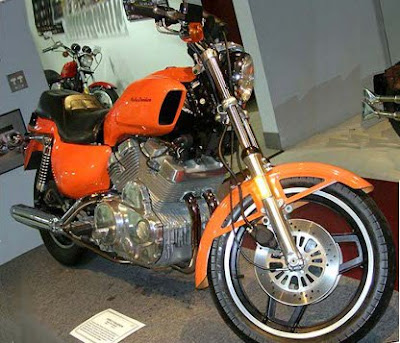
Left picture courtesy - Lee A. Wood, Source - Bearspage
What happened?
The Nova grew out of a series of meetings held in mid-1976 that is still referred to in Harley executives lingo as the Pinehurst meetings. There it was decided that due to the proliferation at the time of high-tech motorcycles from other countries, and their wide acceptance by American motorcyclists, a redesign of the current 74 (1,200cc) shovelhead engine would be insufficient to guarantee the companys long-term growth. So planners proposed a two-pronged strategy to ensuring Harleys future. First, because of the established product lines loyal following, they set into motion an advanced V-twin project with the goal of updating the shovelhead Big Twin and Ironhead Sportster. The eventual result was the Evolution engine. At the same time, an all-new machine with advanced technology would be developed to appeal to riders who wanted more contemporary performance. Harleys engineers laid out a number of concepts including a series of motorcycles powered by three basic multicylinder, water-cooled engines in six displacements-the Nova family-all incorporating the latest technology. Subsequently, the planners had mapped out Harleys future as a manufacturer of both traditional and cutting-edge motorcycles. The Novas mission was to penetrate the 500cc to 1,000cc market-Harleys smallest air-cooled V-twin engine was 1,000cc (the Sportster)-and attract the growing population of performance-hungry riders.


The Nova family, which perfectly bracketed the most popular segments of the world market, could both fill voids in the American market and give Harley a presence on the international scene. But Harleys engineering resources would be severely stretched with both programs. While most of the designers were motorcycle enthusiasts, not all were card-carrying engineers. The task of developing the Evo, in both Sportster and Big Twin iterations, was daunting enough-the Nova would overload H-Ds engineering capacity. The solution was to farm out the powertrains design and development. Harley solicited detailed design proposals from three companies, Porsche was eventually selected and subcontracted at the end of 1979 to design and develop the Nova engine and transmission. All chassis development and testing would be done in Milwaukee. To cover the desired range of displacements, the Nova family would share many common, interchangeable components. The basic concept revolved around a 60-degree V-cylinder arrangement of two, four and six cylinders. Other requirements included liquid cooling, double overhead camshafts, a balance shaft to reduce vibration and a five-speed gearbox. The valve gear and even the gearbox were to be interchangeable. In addition to carbureted models, a fuel-injected version would also be developed. All the engines were designed to use either 200cc or 250cc "wet" cylinder liners and pistons.  These would interchange between the V-twin, V-4 and V-6 engines. So the 800cc and 1,000cc fours are basically made of two 400/500cc twins, and the 1,200cc and 1,500cc six-cylinder versions consist of three banks of twins. The bore sizes were set at 66mm and 74mm (2.60 and 2.91 inches) for the 200cc and 250cc cylinder displacements, respectively, with a common stroke of 58mm (2.28 inches). This gave a very modern oversquare bore/stroke ratio of 1.14:1 for the smaller engine and 1.28:1 for the larger size. The short stroke would allow these engines to rev safely to nearly 10,000 rpm, an impossible speed for a 5,000-rpm Big Twin with its long stroke of nearly 4 inches. The cylinder heads feature two valves with bucket tappets actuated directly by overhead cams. Harley looked seriously at a four-valve head, but staying close to its conservative philosophies, chose the least complicated configuration while not ruling out a change later on-the production two-valve heads were designed to be adaptable to a four-valve layout. Harley engineers had developed a preliminary design for the entire family before the detail design of the first engine-the 800cc Nova 8-was started. This size was considered the middle ground of displacement ranges thought to be the most promising. The cylinder bore and stroke were also based on engineering analysis of noise management, something Porsche had considerable experience with. As engine development proceeded, the chassis designers weighed the final-drive options. Belt final drive was not perfected then, and they chose not to trust it for the high-performance Nova. That left either shaft drive and chain drive. Despite its advantages in terms of cleanliness and low maintenance, shaft drive was seen as too complex, too heavy, and too costly to repair or replace. It also absorbed about three percent of the engines power every time the drive changed direction, twice in the Novas case. Despite Harley engineerings reluctance to adopt the shaft, it proceeded with that alternative. In fact, there was even open discussion of turning the engine 90 degrees in the frame, with the cylinders protruding sideways in an arrangement similar to Moto Guzzis; this would eliminate one of the two right-angle drives in the shaft. That discussion was quickly dropped. By the time the FLT hit the market in the fall of 1979, belts had been proven and the shaft lost what little appeal it had for Harley engineers. The final drive of choice became the belt, with a chain option. Besides, if needed, the shaft could always be resurrected in the future.


The Nova was never intended to look like any of the traditional Harley V-twins, since its target market consisted of performance-oriented riders accustomed to the styling of Harleys overseas competition. But Willie G. Davidson, who oversaw the Novas appearance, refused to buy into the function-over-form philosophy prevalent in the styling of high-performance bikes of the day, insisting that a large, flat radiator stuck on the front of the bike was an affront to the eye. It was his insistence on a concealed radiator that led to one of the Novas most unusual-and patented-features, an underseat radiator. The radiator lies almost horizontally, with two large forward-facing scoops protruding forward from what normally would be the fuel tank, funneling air into a plenum chamber above the radiator. A fan under the radiator pulls air through it, down and rearward, away from the rider and passenger. What began as a styling imperative offered inherent advantages. The air intake is mounted well above ground level, preventing debris from being sucked into the radiator. Because the airflow is channeled and controlled, a smaller radiator can be used with greater efficiency. And almost as important at the time, the "invisible" radiator kept Willie G. and his stylists happy. A pressed-steel backbone-style frame-strong, light, and easy to manufacture-has a rear subframe welded to it, and uses the engine as a structural member. With no front downtubes or radiator, the engine bay has a clean look, and the cylinders "cooling fins" give the engine an appearance of being air-cooled. With the fuel tank displaced from its traditional location by the cooling system, H-D engineers designed a saddlebag-style tank that straddles the radiator. There is a distinct advantage in this location: a lower center of gravity. Engineers had minor concerns about the possibility of vapor lock caused by radiator heat, and the problems associated with the fuel pump and plumbing-required by the tanks low position-but these issues were considered easily surmountable. The tanks placement also limits fuel capacity, and therefore range.


The solution, though not elegant, is huge side panels, perhaps the Novas single styling blemish. As dyno rooms hummed and prototypes logged test mileage, the Nova appeared close to launch. A project of the Novas scope, however, required solid backing from the check-writers at the corporate level, and Harleys parent company at the time, American Machine and Foundry (AMF) not only backed the Nova, but supported Harleys overall growth. Under the direction of AMF president Rodney C. Gott, who was a motorcycle enthusiast, Harley acquired the York final-assembly plant. The company grew with the influx of capital, and new people were brought in. In the years of 1978 through 1980, the motorcycle division was perhaps AMFs largest profit center.Then Gott retired, Tom York took over AMF, and the outlook suddenly changed. Previously AMFs business was roughly half industrial and half leisure, Harley being part of the latter group. In a major shift in strategy, York ordered the expansion of the industrial side, and financed it with profits from the leisure side. Under this plan Harley-Davidson, AMFs largest profit generator, would become the cash cow, milked of capital to feed other business interests. The Nova project, ultimately considered expensive and risky, fell victim to the bottom line, and was terminated.
In a way, however, the Novas demise sparked Harley-Davidsons resurgence. Cutting Nova funds was one of the reasons Beals led the so-called "gang of 13" to propose buying the company back from AMF. AMF agreed, and by mid-1981 Harley-Davidson became a privately held company. Highly leveraged with an enormous bank debt, Harleys future options boiled down to just two-either continue development of the Evolution V-twin, or build the Nova. The Nova was the long-range hope, the 10-year promise. But air-cooled twins promised the most immediate cash flow. And so the Nova died yet another death. Even so, Harley execs continued searching for investors to fund a manufacturing plant for the Nova. As late as 1984 Beals made presentations to many companies in the United States and Europe, but had no success. Among the what-ifs that inevitably attend a story of shattered dreams are these: What if Harley-Davidson had gone ahead with the Nova? What would it look like today, and how would it compare to its competition? And theres another question thats just as intriguing; what if Harley had chosen the other path, and dropped the Evolution altogether in favor of the Nova?
Another Harley Davidson prototype was the VR-1000 (picture below). The story... here

HARLEY DAVIDSON SOFTAIL DELUXE
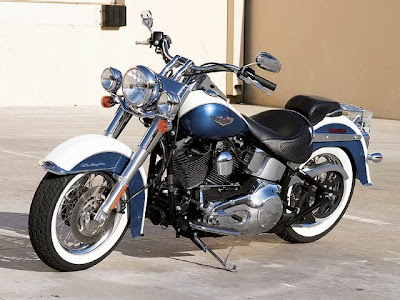

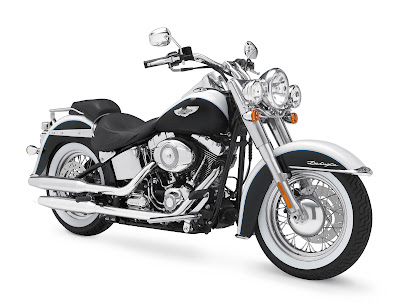

Now if you think about looks, then you should not worry as its sure to enhance your reputation on the roads with its bulky and macho body. Either on a highway or over city roads, there is no such place where you wont attract attention with the new Harley Davidson Softail Deluxe. This one of a kind bike is a total blend of royal looks with amazing performance.
Harley Davidson Softail Deluxe Specifications
Engine Specifications- Engine: Twin Cam 96B
- Displacement: 1584cc
- Torque: 126Nm@3000rpm
- Transmission: 6 Manual Gears
Other Specifications
- Weight: 315.00 kg
- Ground clearance: 122.00 mm
- Fuel tank capacity: 19.00 ltrs
- Brakes: Piston
- Wheelbase: 1639.00 mm
- Wheel size: MT90 B16 - MU85 B16 mm
Colors Available
- Vivid Black
- Flame Blue Pearl
- Red Hot Sunglo